
Cotton Rope vs. Die-Cut Handles: Head-to-Head Decision Guide for Retailers
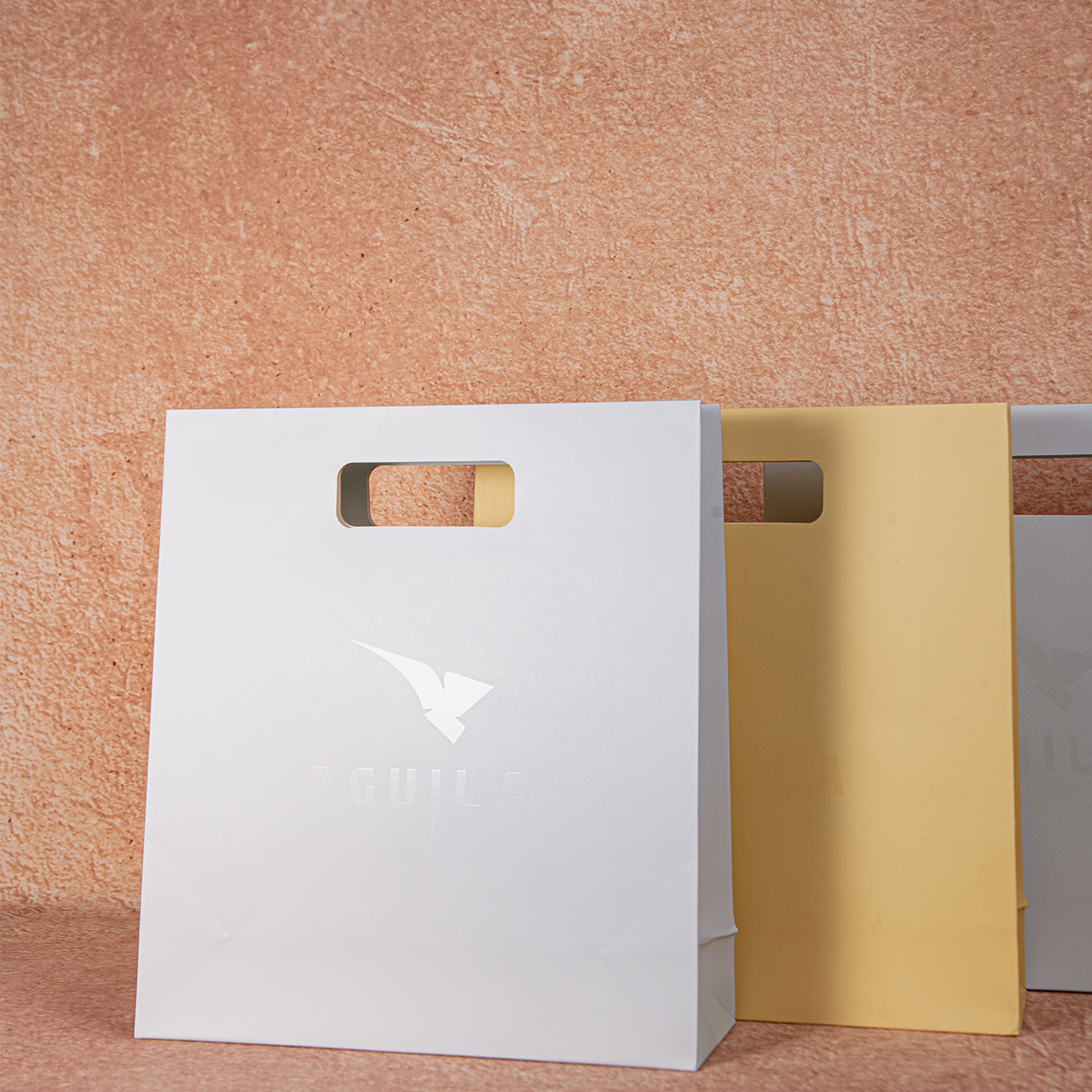
Custom shopping bags differ most at the handle: cotton rope adds a second material and a premium cue, while die-cut keeps the bag a single paper article.
Cotton rope and die-cut handles are the two most consequential handle choices in a custom shopping bags programme, and they pull in opposite directions. Cotton rope delivers the tactile, gift-like unboxing that premium retail leans on. Die-cut delivers a single-material bag that is simpler to sort, flatter to store and easier to cost-control at volume.
The decision rule, in one line: choose cotton rope when the bag's job is to make the brand feel expensive; choose die-cut when the bag's job is to move volume without adding a second material or a second compliance conversation.
This guide is written for the evaluation stage — the point where a retailer has already shortlisted bag formats and now has to defend one handle decision internally to merchandising, sustainability and finance at the same time. It compares construction, brand perception, load behaviour, material end-of-life, documentation and cost structure, then closes with a step-by-step selection routine, a comparison table and a scenario shortlist.
Why the Handle Is a Procurement Decision, Not a Design Detail
The handle is the only part of a shopping bag that the customer physically loads, grips and carries. That single fact turns a small component into a decision that touches four departments at once.
- Brand perception. The handle is the first tactile signal in the unboxing sequence, before the print is fully read and before the bag is set down.
- Structural performance. Handle attachment and handle aperture are the load-transfer points. Opack specifies its custom shopping bags for 2–15 kg depending on paper thickness and structure, so the handle choice has to be evaluated inside that envelope rather than in isolation.
- Material story. A die-cut handle keeps the bag to one material. A cotton rope handle makes the article a two-material construction, which changes how the bag is described to customers and to recycling schemes.
- Cost and lead time. One handle adds a component and an assembly step; the other does not. That difference compounds across a large seasonal order.
Retailers who treat the handle as a late-stage aesthetic pick usually re-open the specification after sampling. Retailers who treat it as a procurement variable usually settle it before the first proof is approved.
Industry Background: Why Handle Choice Moved Up the Agenda
Three market signals have pushed handle selection from the design file into the buying brief.
1. The category is large and the premium end is growing. Zion Market Research values the global paper-based consumer bags market at USD 5.29 billion in 2023, and projects a 13.8% CAGR for the premium price segment through 2034. That premium segment is exactly where cotton rope handles are positioned: high-grammage paper, reinforced handles and certified material.
2. Certification is now a consumer-facing attribute. FSC certification is the primary industry standard for sustainable paper sourcing and is recognised by 56% of consumers worldwide. A handle decision therefore interacts with a claim a retailer may want to print on the bag or publish on a product page.
3. Regulation has become traceability work. The EU Deforestation Regulation (EUDR), effective 2025, requires paper packaging to be traceable back to geolocated forest plots. Traceability is a paper-chain exercise, which means every non-paper component in the bag — including a cotton cord — has to be documented separately rather than absorbed into the paper claim.
Suppliers also signal positioning through the handle sets they publish. Cubit Packaging lists kraft, shopping and euro tote styles with die-cut, twisted or flat handles. MrTakeOutBags lists rope handles on coated virgin paper eurototes with matte or gloss finishes. EcoEnclose documents square-bottom kraft bags with twisted paper handles and notes that its paper bags are made in the USA by default while some die-cut handle bags are made overseas by default. Read together, these catalogues show that handle choice is used as a market-positioning signal, not just a functional option.

Handle construction is usually visible at a glance, which is why it reads as a brand signal before the customer has read a single word of print.
Cotton Rope Handles: Construction, Strengths and Boundaries
A cotton rope handle is a separate cord, threaded through punched holes in the bag top and anchored by knotting or an internal fixing. Because it is a distinct component, it sits outside the paper structure rather than being formed from it.
Cotton rope is one of five documented handle options in Opack's custom shopping bag specification, alongside paper twisted, flat paper, ribbon and die-cut handles. Rope is also documented in the wider market: MrTakeOutBags describes rope handles on coated virgin paper eurototes finished in matte or gloss.
Where cotton rope wins
- Tactile contrast. A soft cord against a rigid paper panel creates a material contrast that flat handles do not produce. It is the fastest way to signal a higher price tier without changing the print.
- Grip comfort on heavier loads. A rounded cord distributes pressure across the fingers more comfortably than a narrow paper edge, which matters in apparel and gifting where customers carry the bag for extended periods.
- Gift and VIP framing. Rope handles read as an occasion bag, which suits branded gift bags, launch packaging and holiday programmes.
- Visual finish options. Rope can be specified in a colour that ties into the print, and it combines naturally with the finishing set Opack offers on custom shopping bags, including hot stamping, spot glossy UV, soft touch lamination, holographic foiling, embossing and debossing.
Where cotton rope needs caution
- Two materials in one article. The bag is no longer a single paper object. Whether the cord must be removed before paper collection depends on the local collection scheme the retailer operates in, so the claim printed on the bag should match the actual waste stream.
- Documentation scope. Opack's published FSC Chain of Custody record (certificate GFA-COC-005690, issued by GFA Certification GmbH under FSC-STD-40-004 Version 3.0) lists a scope covering cardboard packaging, sacks and bags of paper, adhesive labels and other pulp and paper products — that is a paper scope. Buyers who need to describe the whole article should confirm how the non-paper handle component is documented and should request the current certificate and validity dates at sampling.
- Assembly dependency. The handle is attached in a separate operation, so anchoring consistency is a quality-control checkpoint rather than an assumption.
Die-Cut Handles: Construction, Strengths and Boundaries
A die-cut handle is an aperture cut directly into the top panel of the bag from the same paper stock that forms the body. Nothing is added. The handle is formed by removing material, not by attaching a component.
Die-cut appears as a standard handle style across supplier catalogues: Cubit Packaging lists die-cut handles alongside twisted and flat options, and EcoEnclose documents that some die-cut handle bags are made overseas by default while its standard paper bags are made in the USA by default — a reminder that the handle style can correlate with origin.
Where die-cut wins
- Single-material construction. Bag body and handle come from one paper stock. This is the cleanest possible recyclability story a retailer can tell, and it removes a component from the bill of materials at the same time.
- Flush, snag-free profile. Nothing protrudes above the bag top, so bags stack flatter, occupy less shelf and shipping volume, and present fewer catch points in a checkout lane.
- Predictable cost structure. With no separate handle and no attachment step, the cost drivers reduce to paper grammage, print method, finishing and order quantity. For high-volume grocery, pharmacy and e-commerce programmes, that simplicity is the whole argument.
- Clean print real estate. The handle sits inside the printed panel rather than interrupting it, which suits full-wrap designs on custom printed paper bags.
Where die-cut needs caution
- Lower perceived premium. A flush handle reads as practical rather than indulgent. For luxury and gifting programmes it can undercut the positioning the print is trying to build.
- Aperture edge wear. Because the grip is a cut paper edge, handle-edge reinforcement and paper thickness carry more of the load rating. Opack's 2–15 kg specification is explicitly conditional on paper thickness and structure, so the die-cut handle should be sampled at the actual load, not assumed from a data sheet.
- Grip comfort. A flat paper edge is less comfortable than a cord over long carrying distances, which is worth testing with real customers in apparel or home goods retail.

Die-cut handles are formed from the bag body itself, so the article stays single-material from body to grip.
Five Criteria That Separate the Two Handles
Every handle debate reduces to these five tests. Score both options against each before requesting samples.
1. Brand positioning. Does the bag need to feel like a gift, or does it need to feel efficient? Premium and gifting programmes lean rope; volume retail leans die-cut.
2. Load path. What weight does the bag actually carry in store, and where does that load transfer? Rope transfers it into an anchored cord; die-cut transfers it into a reinforced paper edge.
3. Material count. Must the bag be describable in one material? If yes, die-cut is the only one of the two that satisfies the requirement without qualification.
4. Documentation. What must you be able to prove to a buyer, an auditor or a customer? Paper-chain certification and traceability evidence apply to the paper components; a non-paper cord needs its own handling.
5. Cost and order size. Compare the two on identical paper, identical print and identical finishing. A handle comparison across different bag bodies is not a comparison.
Step-by-Step: Running the Decision Through a Real Order
Step 1 — Define the tier the bag serves. Separate the range into a standard tier and a premium or gifting tier. A single handle rarely serves both without compromise.
Step 2 — Fix the load target. Decide the maximum in-store load and confirm it against paper thickness and bag structure. Opack rates its custom shopping bags for 2–15 kg depending on paper thickness and structure, and load-tests before production.
Step 3 — Decide whether the bag must be single-material. If the sustainability statement is a headline claim, die-cut removes an entire category of explanation.
Step 4 — Map the documents you must produce. Certificates, traceability statements and recycled-content claims should be listed before sampling so the supplier can respond to the real requirement rather than a generic one.
Step 5 — Sample both handles on the same bag. Same stock, same grammage, same print, same finishing, same load. Only then is the tactile difference a real signal rather than a print difference. Opack supports colour, size, style, finishing, printing method and material customization on custom packaging, which makes like-for-like sampling practical.
Step 6 — Compare quotes on the identical specification, then confirm MOQ and lead time. Opack's custom shopping bag MOQ is 1,000 pcs with a 12–18 day lead time, and every order passes a 100% quality check.
Use Cases: Which Handle Belongs Where
Premium apparel and boutique retail → cotton rope. The bag is carried visibly down a street; the handle does more brand work than the logo at that distance.
Cosmetics and beauty → split by SKU tier. Die-cut for replenishment purchases, cotton rope for gift sets and launch kits. This is where most beauty retailers end up after sampling both.
Grocery, pharmacy and high-volume e-commerce → die-cut. High unit counts, short dwell time and a strong probability the bag is reused for a bin or a storage box. Single-material construction is the decisive advantage.
Trade shows and events → die-cut as the workhorse, rope for VIP kits. Event bags are handled in bulk and often stacked in a booth for hours, which rewards the flatter die-cut profile.
Gifting programmes and seasonal launches → cotton rope. The unboxing moment is the product, and the handle is the first thing touched.
One retailer's mixed-range result
A fashion and lifestyle brand in Panama ran a one-year annual purchasing partnership covering retail, gift and promotional packaging: over 30,000 paper bags, over 3,000 paper boxes and over 10,000 stickers annually, with a total annual purchase value above USD 12,000. The project recorded zero quality complaints and zero after-sales issues, with the client reporting high satisfaction with packaging quality, printing consistency and overall production reliability, and with stable lead times and consistent print quality across multiple batches.
The operational lesson for a handle decision is not the order size but the batch consistency. When a range mixes handle styles across tiers, print and assembly consistency across repeated batches is what protects the brand, which is why the sampling step in this guide is framed as a like-for-like test rather than a one-off visual check.
Mixed-range packaging programmes depend on batch-to-batch consistency more than on any single handle style.
Side-by-Side Comparison
The table below uses only documented specification and published claims; it does not price either handle, because unit pricing depends on grammage, print method, finishing and order quantity.
| Decision factor | Cotton rope handle | Die-cut handle |
|---|---|---|
| Construction | Separate cord threaded through punched holes and anchored by knot or fixing | Aperture cut directly into the bag top from the same paper stock |
| Material count | Two materials: paper plus cotton cord | One material: paper only |
| Brand perception | Tactile, gift-like, commonly used in premium and luxury retail | Practical, uniform, reads as efficiency rather than indulgence |
| Grip comfort | Rounded cord distributes pressure across the fingers | Flat paper edge; comfort depends on grammage and edge reinforcement |
| Load behaviour | Load transfers into the anchored cord and the fixing point | Load transfers into the cut paper edge and top panel |
| Storage and stacking | Cord protrudes above the bag top | Flush top; bags stack flatter |
| End-of-life story | Two materials; separation requirement depends on the local collection scheme | Single-material article; simplest statement a retailer can make |
| Documentation | Paper components fall under the paper chain-of-custody scope; the cord needs separate handling | Entire article sits within the paper specification and its certification record |
| Cost drivers | Paper, print, finishing, plus a handle component and an attachment step | Paper, print, finishing and order quantity only |
| Best-fit retail format | Boutique apparel, cosmetics gift sets, VIP and seasonal gifting | Grocery, pharmacy, e-commerce, trade shows, high-volume retail |
Basis: Opack custom shopping bag specification (handle options, 2–15 kg rating, MOQ 1,000 pcs, 12–18 day lead time, 100% quality check); Opack FSC Chain of Custody scope; published handle options from Cubit Packaging, MrTakeOutBags and EcoEnclose.
Scenario shortlist: which handle ranks first for your format
| Retail scenario | First choice | Reason |
|---|---|---|
| Luxury apparel or jewellery | Cotton rope | Highest perceived value at the moment of handover |
| Seasonal gifting and VIP kits | Cotton rope | Occasion framing; matches branded gift bags positioning |
| Cosmetics everyday retail | Die-cut | Volume, storage efficiency, single-material claim |
| Grocery, pharmacy, convenience | Die-cut | Fast checkout flow, no protruding component, predictable unit cost |
| E-commerce and fulfilment inserts | Die-cut | Flatter packing density and simpler returns handling |
| Trade shows and events | Die-cut, with rope for VIP | Bulk handling rewards the flush profile; VIP kits reward the tactile cue |
Certification records cover the paper components of a bag; a non-paper handle needs its own documentation path.
Frequently Asked Questions
Is a cotton rope handle covered by FSC certification in the same way as a paper handle?
No — the certification applies to the paper chain. Opack's published FSC Chain of Custody record (certificate GFA-COC-005690, issued by GFA Certification GmbH under FSC-STD-40-004 Version 3.0) lists a scope covering cardboard packaging, sacks and bags of paper, adhesive labels and other pulp and paper products. Cotton cord is not a pulp or paper product, so it falls outside that stated scope. Retailers who need to describe the whole article should confirm at sampling how the non-paper handle component is documented and should request the current certificate with its validity dates. The same logic applies to EUDR traceability, which is built around forest-risk commodities and geolocated plots rather than textile components.
Can both handle styles be produced on the same order, and do they carry the same load rating?
Yes on both counts, with one condition. Opack lists cotton rope and die-cut among the handle options on its custom shopping bag specification, alongside paper twisted, flat paper and ribbon handles, so a mixed range can be produced from one supplier and one print specification. The load rating, however, is not attached to the handle name. Opack specifies its custom shopping bags for 2–15 kg depending on paper thickness and structure, and load-tests before production. A die-cut handle on a light stock and a cotton rope handle on a heavy stock will not behave the same way in store, so each handle-and-grammage combination should be sampled at the actual load it will carry.
Which handle is cheaper per unit?
There is no universal answer, and any supplier quoting one without a specification is guessing. What can be stated structurally is the cost driver: a die-cut handle removes a separate component and its attachment step from the bill of materials, so its cost reduces to paper, print, finishing and order quantity. A cotton rope handle adds a cord and an attachment operation. The honest way to compare is to fix the bag body, grammage, print method, finishing and quantity, then request both versions in the same quote. Opack's custom shopping bag MOQ is 1,000 pcs, which sets the volume baseline for that comparison, and customization covers material, colour, size, style, finishing and printing method so both variants can be built on an identical body.
Can I get samples of both handle styles before committing to a production run?
Sampling is the correct next step after the five criteria in this guide, and it should be a controlled comparison rather than a visual check. Request both handles on the same bag body with the same paper stock, the same print method and the same finishing, then load both, carry both and store both under the conditions your customers will actually create. Opack handles sample and specification requests through its sales team at sales@opack.com, by phone on +86 17366633702, or via WhatsApp on +86 15968809016. The full capability and product range is summarised in the Opack company profile.
What is the lead time for custom shopping bags with either handle type?
Opack's production lead time for custom packaging is 12–18 days, with a monthly capacity of 1,000,000 units and a 100% quality check on every order. Because a cotton rope handle adds an attachment operation that a die-cut handle does not, the two variants should be scheduled separately rather than assumed to share a slot, particularly in a seasonal window where the whole range ships at once. Manufacturers are based in Longgang, Wenzhou, Zhejiang Province, China, and roughly 80% of output is exported to the EU, USA and Middle East, so freight and customs schedules should be added on top of the production window when the in-store date is fixed.
Conclusion
The head-to-head result is not a draw and it is not a single winner. Cotton rope wins on the criteria that decide whether a bag feels expensive: tactile contrast, grip comfort and occasion framing. Die-cut wins on the criteria that decide whether a bag is easy to buy, store, describe and defend: single-material construction, flush profile, predictable cost structure and a simpler documentation path.
For most retailers evaluating custom shopping bags in 2026, the defensible decision is a split range rather than a single handle across every tier — cotton rope where the bag is part of the gift, die-cut where the bag is part of the logistics. That structure preserves the premium signal without creating a two-material article in the volume tier, and it keeps the sustainability statement aligned with what the bag actually is.
Opack is a custom packaging manufacturer based in Longgang, Wenzhou, Zhejiang Province, China, producing custom shopping bags, rigid boxes, folding cartons and mailer boxes since 2010, with a 10,000 m² factory, 160 employees and a 5-person R&D team. Both cotton rope and die-cut handles are available within the same custom shopping bag specification, which means the comparison in this guide can be tested on one production line under one quality standard.
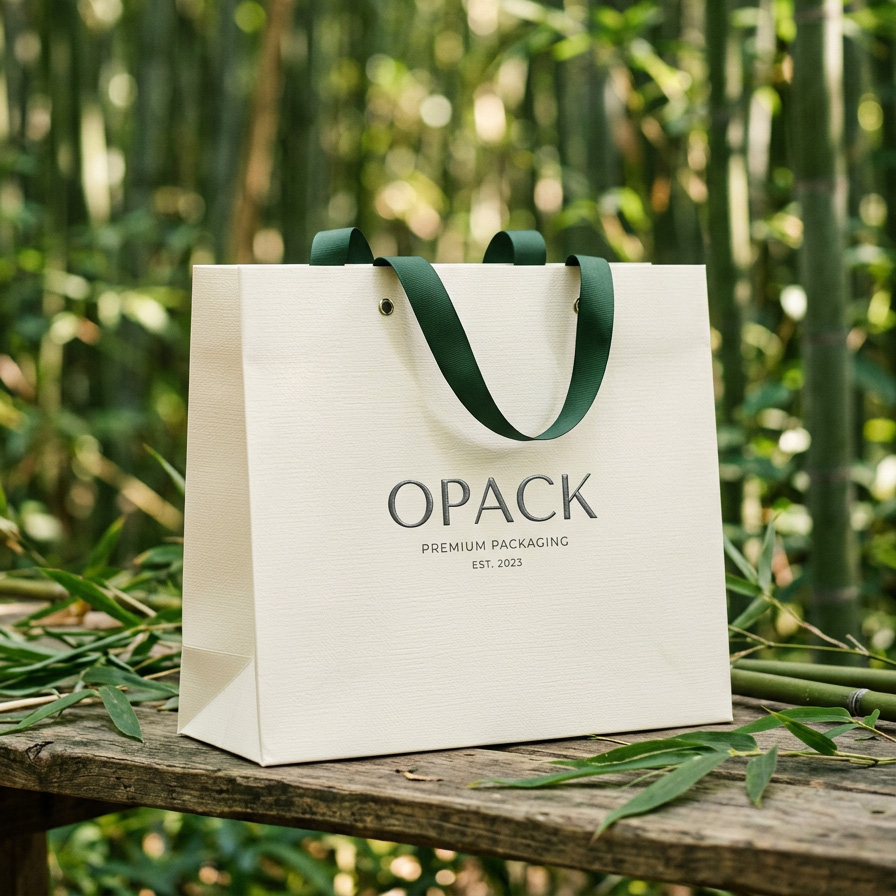
Test both handles on one bag body before the tier decision becomes a purchase order.
Next step: sample both handles, then decide
Request a cotton rope sample and a die-cut sample on the same bag body, or ask for a quote on a split range covering your standard and premium tiers. Opack's team responds through sales@opack.com, +86 17366633702, or WhatsApp +86 15968809016.
Company profile and full product range: download the Opack catalogue · www.opack.com
Have Questions or Need More Details?
Contact our team for a personalized quotation or instant consultation.
Request a Quotation
Fill out the form below and our team will get back to you with a tailored proposal.
WhatsApp Direct Chat
Prefer to chat in real-time? Message us on WhatsApp for instant assistance & quick answers.
- Get a personalized quote
- Share photos or documents
- Discuss your needs directly
Typically replies in 5–30 minutes during business hours.