
Magnetic Closure vs. Ribbon Closure: A Head-to-Head for Rigid Gift Boxes
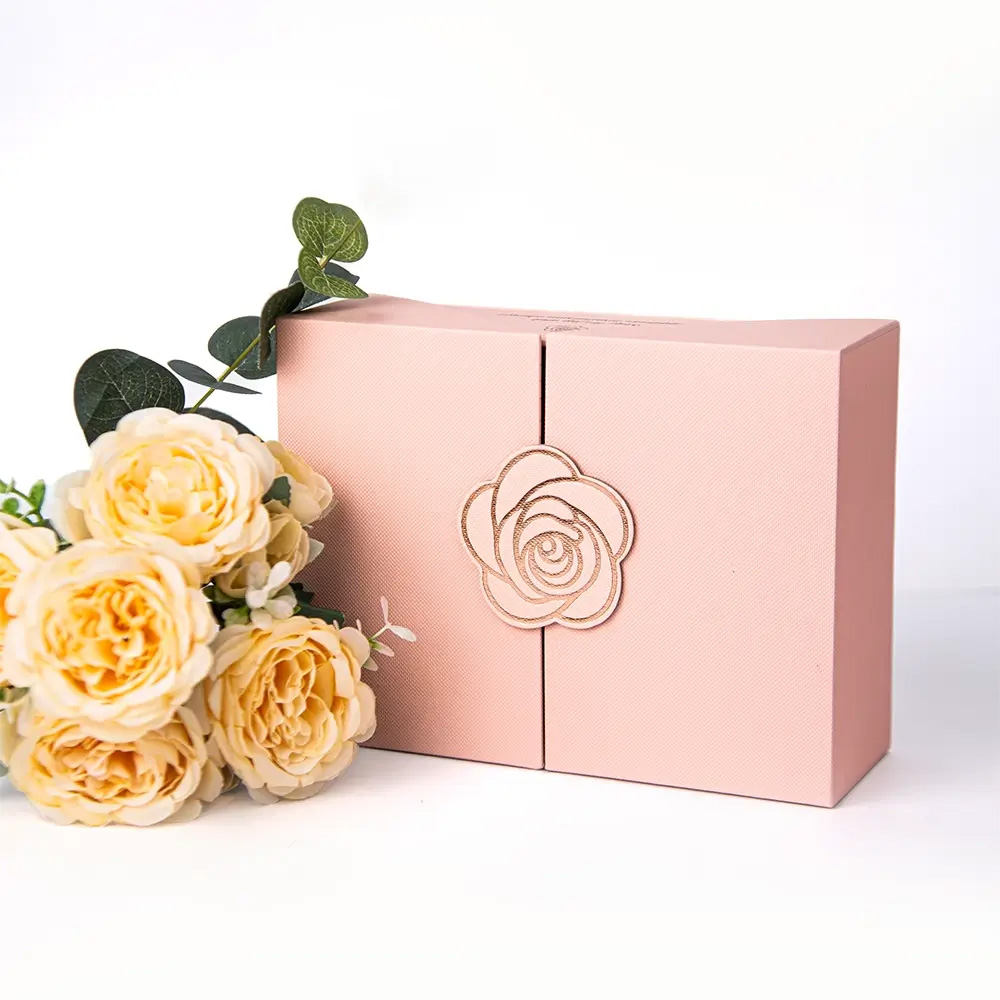
A rigid gift box body from Opack's custom rigid box range. The same construction can be specified with a magnetic closure or a ribbon closure.
Short answer: specify a magnetic closure when the lid top is your main brand surface and the box should be reopened and reseated; specify a ribbon closure when the ribbon itself is a brand signature and the box is a gift object that gets photographed before it is opened. Both are listed structural options on the same Opack rigid box platform, so the real decision is about the opening sequence, the printable lid area, reuse intent and component count — not about which closure is better in general.
Magnetic closure and ribbon closure appear side by side in most rigid box specification sheets, which makes the choice look cosmetic and lets it slip to the artwork stage. In practice it is one of the last decisions that can be made cheaply, because it touches the dieline, the artwork placement, the finishing plan and the number of hand operations in assembly. This head-to-head is written for brands preparing a premium retail edition — a holiday gift set, a limited fragrance launch, a jewelry presentation box — and for the buyers and brand managers who have to lock the structure before the print file is released.
What a closure changes — and what it does not
Opack is a custom packaging manufacturer established in 2010 in Longgang, Zhejiang Province, China, producing folding cartons, rigid boxes, mailer boxes, paper shopping bags and paper tubes for apparel, cosmetics, retail, gifting and jewelry customers.
For its custom rigid boxes, Opack publishes a single platform specification: grey board or MDF with customizable thickness; wrapping paper in coated paper, kraft paper, specialty paper, textured paper or white paperboard; printing in CMYK, Pantone, UV, offset or screen; finishing in hot stamping, spot glossy UV, soft touch lamination, holographic foiling, embossing, debossing, matte lamination or gloss lamination; structure available as foldable, magnetic closure or ribbon closure; inserts in foam, paperboard, EVA, plastic tray, corrugated cardboard or silk; and an MOQ of 500 pcs across the RB-C01, RB-G02, RB-M03, RB-L04, RB-B05, RB-O06, RB-T07, RB-D08 and RB-W09 model designations.
Because both closures sit on that shared base, choosing between them does not change board grade, print method or insert logic. What it does change is narrower and far more consequential: how the box opens, how much of the lid top remains available for artwork, whether the pack survives being reopened, and how many components and manual steps sit inside the unit cost.
The problem: when both options are listed, the spec sheet decides nothing
The failure mode is rarely a wrong technical choice. It is a choice made too late. Three patterns repeat across premium rigid box projects.
Artwork reflow after the dieline is approved. A lid design built for a full continuous printed panel does not transfer cleanly to a lid crossed by a ribbon. Logos, foil blocks and fine type have to be repositioned around the ribbon path, and the foil edge tolerances that looked comfortable on a flat panel suddenly sit next to a three-dimensional element. Releasing artwork before the closure is locked is the single most common cause of a second print proof.
A sample round that validates the wrong thing. Teams approve a sample on colour and board feel, then discover at retail that the lid does not reseat cleanly after the first opening, or that a deliberately tied ribbon loosens in a shopping bag. Closure behaviour is a use test, not a visual test, and it has to be checked on a physical sample of the final structure.
A cost surprise attributed to the wrong driver. Buyers often assume the closure is a minor line item and are then surprised by the unit price. The closure contributes through component count and hand operations, but on many projects the deciding cost factor is the number of finishing steps — hot stamping plus spot UV plus embossing on the same wrapped lid — rather than the closure itself. Comparing magnet against ribbon without holding the finish plan constant produces a misleading answer.
None of these are solved by reading a specification. They are solved by deciding the closure before artwork and by testing it in the sample stage.
Industry background: why closure now carries a compliance question too
The premium end of the market this decision sits in is large and still expanding. Towards Packaging / Future Market Insights put the global luxury rigid box market at USD 8.84 billion in 2026, with cosmetics and personal care leading application share at 37%. Grand View Research projects the broader rigid packaging market — a wider scope that includes plastic and metal rigid formats, not only paperboard gift boxes — at USD 796.7 billion by 2030. China remains a major supply base for the paperboard segment, with rigid box exports under HS code 481920 recorded at USD 1.7 billion in 2023.
Two things follow from that. First, closure options are a mainstream purchasing variable rather than a niche request, which is why manufacturers list them as standard structures. Second, the regulatory frame around packaging has tightened. Regulation (EU) 2025/40, the EU Packaging and Packaging Waste Regulation, requires all packaging to be recyclable and properly labelled, and has applied since 12 August 2026. For a brand preparing a premium retail edition for the European market, the closure conversation therefore has a second question attached: what extra component does the closure add, how is it handled at end of life, and how is the pack labelled.
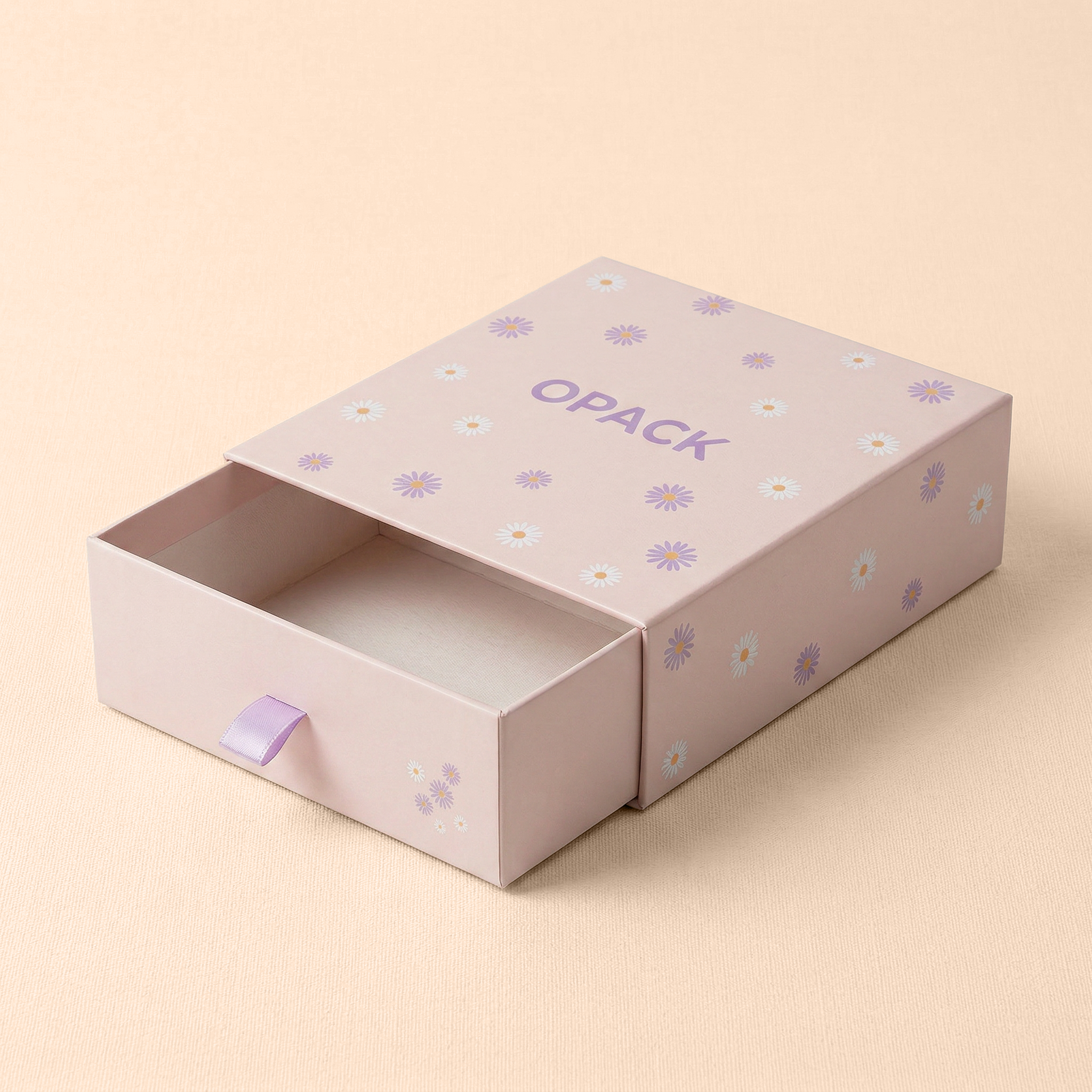
Premium rigid gift box with a wrapped lid. Finishing steps applied to the wrap — hot stamping, spot UV, embossing — are usually a larger cost variable than the closure itself.
Where this fits: Opack's application data describes rigid presentation packaging used for product protection in storage and transit, for brand identity and for communicating brand story, operating as reusable rigid presentation packaging in dry, low-humidity, stable moderate temperature conditions, away from direct sunlight and chemicals. Closure choice should support that brief — protection first, then presentation.
Where the two closures actually diverge
1. Tactile experience and the opening sequence
The magnetic closure produces a lift-off lid that releases when pulled and can be reseated without any action other than lowering it. The handling moment is quiet, two-handed and repeatable — which is why it suits presentation formats where a salesperson or the end buyer opens the box in front of someone else.
The ribbon closure makes the opening a deliberate act. The ribbon has to be released or untied before the lid comes off, which lengthens the sequence and creates a step the recipient performs themselves. For a gift object, that delay is the point. For a pack that will be opened and closed several times in a retail environment, the same delay becomes friction.
2. Reuse potential
Reuse behaviour follows directly from the opening mechanics. A magnetic closure returns to a closed state as soon as the lid is lowered, so the box can be used as storage after purchase without the user doing anything extra. A ribbon closure requires the user to retie the ribbon each time, and a ribbon that has been tied once may not sit identically the second time.
If the packaging brief includes reuse — keepsake storage for jewelry, a cosmetics box that lives on a dressing table, a presentation box retained after a corporate event — the magnetic closure removes a small but real barrier. If the box is expected to be opened once, photographed and discarded, that advantage does not apply.
3. Print surface and artwork constraints
This is where magnetic and ribbon closures differ most for the design team. A magnetic-closure lid keeps the top panel as a continuous wrapped surface, so CMYK artwork, Pantone blocks, holographic foiling and hot stamping can be laid out across the full lid without interruption.
A ribbon closure consumes part of the lid top. The ribbon path has to be reserved in the dieline and in the artwork, which reduces the usable面积 of continuous print and forces the layout to work with a physical line across the panel. Centred logos, wide foil bands and edge-to-edge patterns all need to be re-planned. In exchange, the ribbon itself becomes a design element that flat print cannot replicate — a colour accent, a textural contrast or a brand-signature colour at the point of handling.
One practical note: Opack's finishing menu — hot stamping, spot glossy UV, soft touch lamination, holographic foiling, embossing, debossing, matte and gloss lamination — is specified for the wrapped surface. If a design calls for foil or print directly on the ribbon itself, that has to be confirmed as a separate construction item at the sample stage rather than assumed from the wrap finishing list.
4. Cost variables
Both closures add to the base box, in different ways. A magnetic closure adds components inside the structure and adds insertion steps during assembly, and it requires the lid and body to be fitted so the closure engages consistently — a fitting requirement that becomes more demanding as box size increases. A ribbon closure adds a ribbon component plus positioning and tying work, and it adds a hand operation that scales with order quantity.
On top of that, three cost variables usually outweigh the closure itself: the number of finishing steps on the wrap, the insert construction, and the order quantity relative to the 500 pcs MOQ. A magnetic-closure box with plain matte lamination and no foil can easily cost less per unit than a ribbon-closure box with hot stamping, spot UV and a foam insert. The only reliable comparison keeps size, board, wrap, insert and finish plan identical and changes one variable — the closure.

Wrap printing: the printable lid surface is where the two closures diverge most for the design team.
Step-by-step: choosing between magnetic and ribbon closure
Step 1 — Define the opening sequence before the dieline. Decide who opens the box, how often and in front of whom. Retail staff opening repeatedly, an end buyer opening once, and a corporate recipient opening at an event are three different briefs and often point to different closures.
Step 2 — Map the lid-top artwork. If the lid carries a full-bleed pattern, a wide foil band or a centred logo with tight margins, magnetic closure protects the layout. If the design has a strong colour block or a quiet panel that a ribbon can cross, ribbon closure is workable and adds a three-dimensional element.
Step 3 — State the reuse intent. If the box is meant to be kept and reused, the magnetic closure's repeatable close is the deciding functional difference. If reuse is not part of the brief, do not pay for it.
Step 4 — Fix the finish plan, then check closure compatibility. Hot stamping, spot glossy UV, soft touch lamination, holographic foiling, embossing and debossing are all available, but they stack. Confirm with the manufacturer which combination fits the chosen closure, particularly where foil sits close to the lid edge or the ribbon path.
Step 5 — Build a like-for-like cost comparison. Request quotes for both closures at identical size, board, wrap, insert and finishing. Count components and manual steps rather than comparing two finished prices from different projects.
Step 6 — Validate on a physical sample. Opack's stated workflow runs quote confirmation and specification details first, then sample approval, then mass production after approval, then shipping. Use the sample to open and close the box repeatedly, check lid seating, check ribbon behaviour, check foil edges and insert fit — not only colour.
Proof and production context
Opack operates a 10,000 m² facility with approximately 160 staff, an annual production capacity of 10,000,000 units and an R&D team of 5 engineers, with main markets in the EU, USA and Middle East. That capacity structure matters for closure choice mainly at the sampling and scaling stage: a closure that adds hand operations is easier to repeat consistently where the assembly process and the R&D review are in the same facility as the sampling.
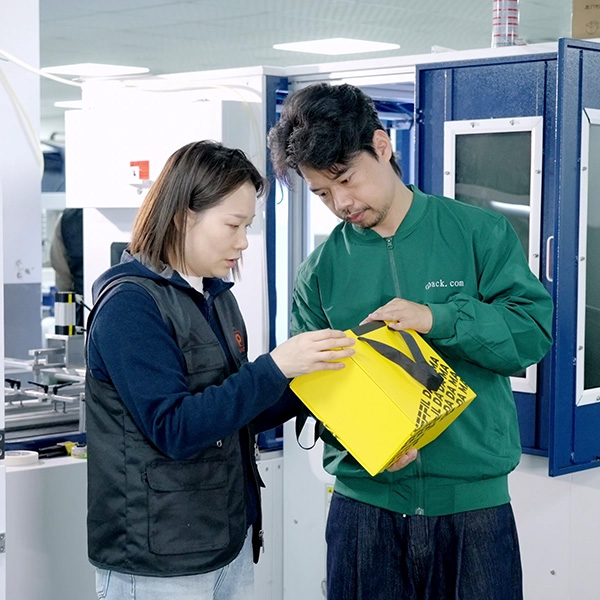
Closure fit and finish inspection. Lid seating and ribbon positioning are checked on the physical sample before mass production.
Use cases: which premium edition suits which closure
Jewelry and watches — magnetic closure. Jewelry and watches are listed application areas for Opack's custom rigid boxes, and these are the formats where the box is most likely to be kept and reused. A lid that reseats cleanly supports that second life, and a continuous lid panel keeps a small logo and a foil mark unobstructed.
Perfume and cosmetics sets — magnetic closure, or ribbon for gift editions. Cosmetics and beauty sit alongside perfumes in the application list, and this is the category where both closures are defensible. A standard retail edition usually benefits from the magnetic closure's clean panel and repeatable close. A holiday or limited gift edition benefits from the ribbon's ceremony, especially when the box is designed to be photographed before opening.
Apparel — ribbon closure. Apparel presentation often follows a book-style or folded format where the ribbon is a functional pull as much as a decorative element, and where the lid does not need to be reseated repeatedly. The ribbon reads as part of the garment presentation language.
Electronics and PR boxes — magnetic closure. Electronics, PR boxes and corporate presentation packaging generally favour a controlled, repeatable open, because the box is often opened in a review, unboxing or press setting where a fumbled tie is a liability.
Corporate and promotional packaging — ribbon closure. Corporate and promotional gifting usually runs at higher quantities with simpler internal structures, and a ribbon supplies perceived value at the point of handing over without changing the box body.
Mixed portfolios are common: the same brand may specify magnetic closure for the retail line and ribbon closure for the gifting line, on the same board and wrap, using different RB model configurations. That is a brand decision, not a structural compromise, and it can be quoted together.
Magnetic vs. ribbon closure at a glance
| Decision factor | Magnetic closure | Ribbon closure |
|---|---|---|
| Structure availability | Listed as a magnetic closure structure option | Listed as a ribbon closure structure option |
| Box body and material | Grey board or MDF, thickness customizable | Grey board or MDF, thickness customizable |
| Wrap and printing | Coated, kraft, specialty, textured or white paperboard; CMYK, Pantone, UV, offset or screen printing | Same wrap and printing options |
| Finishing menu on the wrap | Hot stamping, spot glossy UV, soft touch, holographic foiling, embossing, debossing, matte or gloss lamination | Same finishing menu; foil or print placed on the ribbon itself must be confirmed at sample |
| Lid-top artwork area | Continuous printed lid panel | Ribbon path interrupts the lid panel; layout must be planned around it |
| Added components | Closure components plus lid fitting | Ribbon plus positioning and tying |
| Reopening behaviour | Lid lifts and reseats without extra action | Ribbon must be released and retied each time |
| Typical fit (editorial recommendation) | Jewelry, watches, electronics, PR boxes, reuse-led presentation | Perfume sets, apparel, corporate and promotional gifting |
| Insert options | Foam, paperboard, EVA, plastic tray, corrugated cardboard, silk | Same insert options |
| MOQ | 500 pcs | 500 pcs |
Structure, material, wrap, printing, finishing, insert and MOQ rows are taken from Opack's published custom rigid box specification. Rows describing artwork area, added components and reopening behaviour are design considerations for evaluation, not measured performance data.
Frequently asked questions
Do magnetic and ribbon closures change how a rigid gift box complies with EU packaging rules?
They can affect the compliance file, but not the board itself. Regulation (EU) 2025/40 requires all packaging to be recyclable and properly labelled, and has applied since 12 August 2026. Both closures are built on the same grey board or MDF body with a paper wrap, and Opack's application data specifies eco-friendly water-based printing inks, low-VOC adhesive materials and compliance with FSC standards for this product. Because each closure adds a component on top of the body — a closure set or a ribbon — buyers preparing EU retail editions should ask the supplier to confirm in writing how that extra element is handled at end of life and how the pack is labelled, rather than assuming the material declaration covers it.
Can a magnetic closure be combined with hot stamping on the same rigid box?
Yes. Magnetic closure is listed as an available structure and hot stamping is listed as an available finishing option on the same custom rigid box platform, alongside spot glossy UV, soft touch lamination, holographic foiling, embossing, debossing, matte lamination and gloss lamination. The combination is specified on the RB series models — RB-C01, RB-G02, RB-M03, RB-L04, RB-B05, RB-O06, RB-T07, RB-D08 and RB-W09 — with grey board or MDF bodies and customizable thickness. The practical limit is layout, not availability: foil sits on the wrapped lid surface, so the stamp position must be planned with the closure in the dieline, and any foil intended for the ribbon itself has to be confirmed separately at the sample stage.
Which closure raises the unit price more, magnetic or ribbon?
There is no universal answer, because the closure is rarely the dominant cost line. Both add components and manual steps: a magnetic closure adds closure components and lid fitting, a ribbon closure adds ribbon material and positioning or tying work. On most premium rigid box projects the larger cost variables are the number of finishing steps applied to the wrap, the insert construction and the order quantity relative to the 500 pcs MOQ. A magnetic-closure box with a plain matte lamination can cost less per unit than a ribbon-closure box carrying hot stamping, spot UV and a foam insert. The reliable method is to request both closures quoted on identical size, board, wrap, insert and finishing, so only one variable moves.
How should a buyer validate closure feel before mass production?
Through the sample, not through the specification sheet. Opack's stated workflow is quote confirmation and product details first, then sample approval, then mass production once the sample is approved, then shipping. Use that sample approval step to open and close the box repeatedly, confirm the lid reseats flush, check ribbon behaviour if a ribbon is specified, inspect foil and embossed edges against the artwork, and test the insert with the actual product or a weight-matched dummy. Closure feel, lid seating and finishing edges are use tests — colour approval alone will not surface them.
What lead time should be planned for a rigid gift box order?
Plan around two stages rather than one number: sample approval and mass production. A 2026 third-party comparison article lists a 500-piece starting point and a 12–18 business day turnaround for Opack, but the article does not state its comparison methodology, so it should be treated as a directional signal rather than a benchmark. Production capacity is published at 10,000,000 units per year from a 10,000 m² facility with approximately 160 staff and a 5-engineer R&D team, and the MOQ is 500 pcs. Because the sample must be approved before mass production starts, the calendar should be built backwards from the retail date with the sample round included. To price a specific edition, share the size, quantity, closure preference and finish plan with the Opack team at sales@opack.com for a quote and sample request.
Conclusion: decide on the opening, then on the ribbon
Magnetic and ribbon closures are not competing quality tiers on a rigid gift box. They are two ways of staging the same moment, built on the same grey board or MDF body, the same wrap and print menu and the same finishing list. The magnetic closure protects a full printed lid panel and lets the box close again, which is why it is the safer default for jewelry, watches, electronics and any premium retail edition designed to be reopened. The ribbon closure trades part of that lid panel for a physical brand element and a deliberate opening, which is why it earns its place on perfume gift sets, apparel presentation and corporate gifting.
The decision is cheap at briefing stage and expensive after artwork release. Lock the opening sequence, map the lid layout, state the reuse intent, fix the finish plan, compare both closures on identical specifications, and settle the question on a physical sample.
Request a magnetic or ribbon closure sample
Opack produces custom rigid boxes in grey board or MDF with magnetic, ribbon or foldable structures, wrap options including coated, kraft, specialty, textured and white paperboard, and finishing from hot stamping to soft touch lamination. MOQ starts at 500 pcs, with an R&D team of 5 engineers supporting structural and finishing decisions.
Send your size, quantity, closure preference and finish plan to sales@opack.com or reach the team on WhatsApp at +86 15968809016 for a quote and sample request. The full capability and product range is documented in the Opack company profile (PDF), and the rigid box range is listed at www.opack.com.
Opack · No. 8-10, Prosperity Road, Longgang City, Wenzhou City, Zhejiang Province · Tel: +86 17366633702
Have Questions or Need More Details?
Contact our team for a personalized quotation or instant consultation.
Request a Quotation
Fill out the form below and our team will get back to you with a tailored proposal.
WhatsApp Direct Chat
Prefer to chat in real-time? Message us on WhatsApp for instant assistance & quick answers.
- Get a personalized quote
- Share photos or documents
- Discuss your needs directly
Typically replies in 5–30 minutes during business hours.