
FSC-STD-40-004 Compliance: What Rigid Box Buyers Should Know for EU and US Imports
The short answer: FSC-STD-40-004 (Version 3.0) is the FSC standard behind chain-of-custody (COC) certification, and it is the document set that determines whether a supplier's “FSC certified” claim can actually support an import of custom rigid boxes into the EU or the US. The claim becomes procurement-grade evidence only when three things line up: the certificate holder matches the company you contract with, the certificate scope covers the product you are buying, and the certificate is valid on the date you place the order. A certificate number such as GFA-COC-005690 — held by Opack, a custom packaging manufacturer based in Longgang, Wenzhou, China — is only useful once a buyer can read it field by field.
This guide is written for buyers in the evaluation stage: they have shortlisted rigid box suppliers, they have samples in hand, and they need to know which compliance documents to demand before releasing a purchase order. It decodes FSC-STD-40-004 (Version 3.0), shows how to confirm a certificate number, and marks clearly where the standard stops — including the ink, coating and recyclability questions that chain-of-custody certification does not answer on its own.
The Compliance Gap: Why “FSC Certified” Is Not a Documentation Set
Most rigid box compliance problems at the import stage are not forgeries. They are mismatches — between the entity that holds a certificate and the entity that will run the job, between the scope line printed on a certificate and the construction a buyer has specified, or between the date on a PDF and the date of the order. Each of the four failure modes below can pass through a procurement process unnoticed, because a logo file and a certificate file look equally convincing in an email attachment.
1. Holder mismatch
A chain-of-custody certificate is issued to a specific organisation, and it covers the sites and product scope named on it. If your enquiry is handled by a trading company while production runs in a separate factory, the certificate you were sent may belong to only one of them. Buyers should compare the certificate holder name and address against the name and address on the quotation, the proforma invoice and the shipping documents.
2. Scope mismatch
The scope line is the part of the certificate most buyers skip. Opack's scope, for example, reads “cardboard packaging, sacks and bags of paper, adhesive labels, other pulp and paper products”. A scope like that is relevant to rigid box buyers, but it is not a blanket statement about every component in a finished gift box. Inserts, ribbons, magnets and foam pads are separate materials with their own sourcing. Ask the supplier to state, in writing, which parts of your bill of materials sit inside the certified scope.
3. Date mismatch
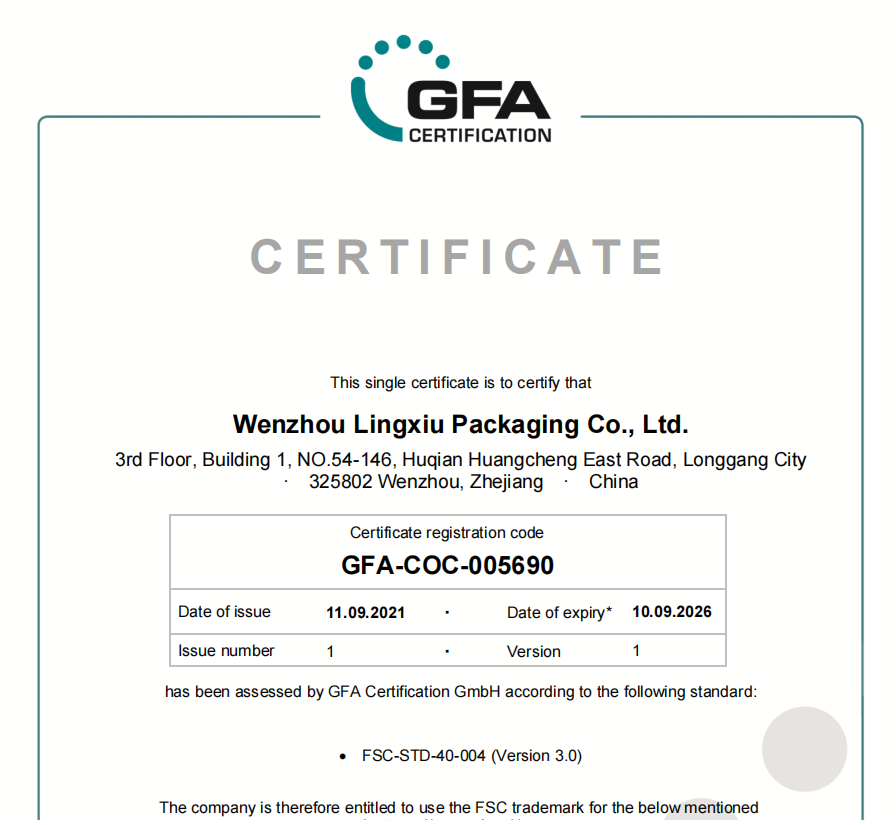
Certificates carry an issue date and an expiry date. Opack's FSC COC certificate was issued on 9 November 2021 and carries an expiry date of 9 October 2026. Certificate files travel: they are forwarded, archived in sales folders and quoted in articles long after the audit behind them was completed. Confirm current validity with the issuing certification body before you rely on the document for a shipment.
4. Standard and version mismatch
The certificate names the standard and its version — in this case FSC-STD-40-004 (Version 3.0). Standards are revised, and a certificate that references an older version, or that a supplier cannot describe in plain terms, is a prompt for further questions rather than an automatic disqualification.
The regulatory backdrop is tightening
In the EU, Regulation (EU) 2025/40 — the Packaging and Packaging Waste Regulation — requires all packaging to be recyclable and properly labelled from 12 August 2026, according to the European Commission's summary of the regulation. PPWR does not itself mandate FSC certification. What it does is put paper-based design and documented fibre sourcing onto the same review checklist for EU-market packaging programmes, which is why chain-of-custody documentation has moved from a “nice to have” attachment to a routine item in 2026 supplier evaluations.
Why Rigid Box Compliance Is Getting More Attention in 2026
Three market signals explain why this documentation question keeps appearing in buyer conversations.
First, the category is large and still growing. Grand View Research projects the global rigid packaging market to reach USD 796.7 billion by 2030, and Towards Packaging / Future Market Insights sizes the luxury rigid box segment specifically at USD 8.84 billion in 2026. Second, demand is concentrated in categories where brand compliance teams are active: cosmetics and personal care account for a 37% share of rigid box applications in the same FMI dataset. Third, the sourcing base is concentrated. China's exports under HS 481920 were reported at USD 1.7 billion in trade value in 2023 by Market.us. HS groupings do not map one-to-one onto rigid setup boxes, so treat that figure as directional — but it does explain why EU and US buyers spend so much of their evaluation time on documentation from Chinese suppliers.
Read together, these signals point to one practical conclusion: for a brand owner or importer, the FSC file is a market-access document rather than a marketing asset. It belongs in the procurement folder next to the specification sheet, not in a brand presentation.
What FSC-STD-40-004 Covers on a Rigid Box Order
FSC-STD-40-004 (Version 3.0) is the standard against which an organisation's chain-of-custody system is certified. Chain of custody is the documented link between certified fibre that enters a factory and the finished packaging that leaves it; the certificate is issued by an accredited certification body and names the organisation, the sites, the product scope and the validity period. Opack's certificate is issued by GFA Certification GmbH under certificate number GFA-COC-005690, and its declared market coverage spans Europe, North America, Australia & New Zealand and the Middle East.
| Certificate field | Opack's FSC Chain of Custody certificate |
|---|---|
| Certificate holder | Opack |
| Certificate number | GFA-COC-005690 |
| Certification type | FSC Chain of Custody (COC) certification |
| Standard and version | FSC-STD-40-004 (Version 3.0) |
| Certification body | GFA Certification GmbH |
| Certified scope | Cardboard packaging, sacks and bags of paper, adhesive labels, other pulp and paper products |
| Market coverage | Europe; North America; Australia & New Zealand; Middle East |
| Issue date | 9 November 2021 |
| Expiry date | 9 October 2026 |
Buyer note: a certificate is a snapshot. If you are placing orders near the end of a certificate's validity period, ask the supplier to confirm the current status of the certificate — including whether a renewal audit is scheduled — in writing, and keep that confirmation with the order file.
Limit one: the certificate covers an organisation and a scope, not every SKU
A COC certificate does not automatically certify each individual box, insert or accessory you order. It certifies the organisation's system and the product categories listed in its scope. For rigid boxes, the relevant scope entry is “cardboard packaging”. Buyers should ask the supplier to confirm in writing which structural elements of their order — greyboard, chipboard or MDF bodies, wrapping paper, printed lid, ribbon, magnetic closure, foam, EVA or silk insert — are covered by the certified scope and which are sourced separately.
Limit two: chain of custody does not describe ink, coating or VOC content
Chain-of-custody certification addresses fibre tracking. It is not a chemistry specification. If your brand carries a low-VOC or water-based ink requirement, treat it as a separate question and put it in writing. Useful prompts for a rigid box supplier include: which ink system is proposed for the print — offset, screen, UV or a combination, all of which appear in Opack's published rigid box printing options; whether the coating or lamination proposed for your job is water-based or solvent-based; which finishing steps touch the printed surface, given that hot stamping, spot glossy UV, soft-touch lamination, holographic foiling, embossing, debossing, matte lamination and gloss lamination are all listed options; and what the supplier can provide as written confirmation of those answers. These questions sit alongside the FSC file, not instead of it.
A Seven-Step Verification Sequence for Custom Rigid Box Orders
The sequence below takes roughly as long as one supplier call, and it produces a file you can hand to a compliance team.
- Request the certificate PDF, not a logo file. A logo may be used in presentations; a certificate carries the fields you need. Ask for the full document, including the annexes that list sites and scope.
- Match the holder name to your contracting entity. Compare the certificate holder with the entity named on the quotation, the proforma invoice and the shipping documents, and with the production address.
- Read the scope line against your bill of materials. Confirm that “cardboard packaging”, or the equivalent scope entry, covers the box you are specifying, and ask which components fall outside it.
- Check the standard and version. The certificate should name FSC-STD-40-004 and its version — Version 3.0 on Opack's certificate.
- Check the issue and expiry dates, then confirm current status. Opack's certificate runs from 9 November 2021 to 9 October 2026; validity at the time of order is what counts.
- Verify the number with the issuing body or FSC certificate records. Certification bodies such as GFA Certification GmbH confirm the certificates they issue, and FSC maintains public certificate records. The number GFA-COC-005690 should resolve to the same holder, scope and validity dates as the PDF you were sent.
- Write the documentation set into the purchase order. Specify which documents travel with the shipment and which stay in the order file, so the evidence survives the handover between your sourcing team, your freight forwarder and your downstream customer.


Where This Verification Work Pays Off
EU beauty and cosmetics rigid gift boxes
Cosmetics and personal care account for a 37% share of rigid box applications, and this is precisely the category feeling the earliest pressure from the EU Packaging and Packaging Waste Regulation, which applies its recyclability and labelling requirements from 12 August 2026. Buyers specifying custom rigid gift boxes for EU retail should treat fibre documentation and material separation as one conversation: a certified paperboard body pairs more easily with a paper-based insert, such as a paperboard or corrugated cardboard tray, than with a mixed-material option.
US premium retail and jewellery packaging
US importers frequently have to answer retailer vendor-compliance questionnaires that ask for the sourcing documentation behind the packaging. For rigid boxes with lids, magnetic closures or ribbon closures, the practical answer is a scope statement from the supplier, matched to the certificate holder — not a logo image. This is also where the earlier inspection of the certificate matters most: retailer programmes tend to re-ask for documentation years after the original sales conversation.
Distributors and wholesalers reselling into regulated markets
A distributor sits between the factory and the brand, and therefore needs the compliance file to be portable. Holding the certificate copy, the scope statement and the confirmation of current validity with each purchase order is what allows a distributor to answer a downstream question in hours rather than weeks.
PR boxes and corporate gifts on short timelines
Time-critical gifting programmes are the hardest place to fix a documentation problem, because the artwork is already approved and the delivery date is fixed. Opack's published rigid box specification lists a minimum order quantity of 500 units and a lead time of 12–18 days; both numbers assume that specification and documentation questions were settled during sampling rather than after artwork release.
Comparing the Documents You Will Be Shown
Not every document carries the same weight. The table below separates what each item actually confirms from what a buyer should do with it.
| What you may be shown | What it actually confirms | What to do with it |
|---|---|---|
| A statement on a supplier website or brochure that the company is “FSC certified” | That the supplier markets an FSC claim. It does not identify a certificate, a scope or a validity date. | Do not file it as compliance evidence. Use it as a prompt to request the certificate PDF. |
| A certificate number shared without the document | Almost nothing on its own. A number must be read together with holder, scope, standard version and dates. | Ask for the full certificate, then verify the number with the issuing body or FSC certificate records. |
| The certificate PDF (for example GFA-COC-005690, issued by GFA Certification GmbH under FSC-STD-40-004 Version 3.0) | Holder identity, certified product scope, market coverage, standard version, issue and expiry dates. | Match the holder to your contracting entity, read the scope against your bill of materials, and confirm current validity. |
| An FSC mark printed on a finished box | An on-product labelling claim. It is not the same document as the chain-of-custody certificate behind the organisation. | Ask which certificate sits behind the label, and confirm that its scope covers that product. |
| A third-party article, directory listing or comparison table describing the supplier | A directional signal at best. The publisher may not be independent and the methodology is often unstated. | Cross-check every claim against certification-body records and the supplier's own documents before relying on it. |
| A signed statement of scope from the supplier, listing which components are certified and which are not | The specific answer your compliance team needs about a particular construction and bill of materials. | Attach it to the purchase order so the answer travels with the job. |
Compliance-First Preference Order: What to Rank First
When buyers compare rigid box suppliers during evaluation, price and finish samples usually dominate the conversation. For regulated imports, that order is backwards. A practical preference sequence looks like this.
- Certificate scope fit, before price. If the certified scope does not cover the product you are buying, no price advantage compensates for the risk, because the documentation problem surfaces after the goods are produced.
- Holder and site identity match, before capability claims. The certificate holder, the quotation entity and the production site should describe the same organisation.
- Current validity, before longevity. A certificate issued in 2021 and valid to October 2026 is meaningful only while it remains valid; confirm status at the time of order rather than trusting an archived PDF.
- A documented production workflow, before verbal assurances. Opack's published workflow runs from quote confirmation and sample approval to mass production and shipping. A supplier that can describe the sequence in fixed steps is easier to audit than one that describes it in adjectives.
- Order economics you can plan against. A minimum order quantity of 500 units for custom rigid boxes, a lead time of 12–18 days and a monthly capacity of 1,000,000 units are planning inputs — they tell you whether your launch schedule and reorder cycle are realistic.
- Depth of the documentation set. A supplier that can provide the certificate, a written scope statement and a sample record, and that performs a 100% quality check before shipment, gives you something to hand to your compliance team. That is a preference criterion in its own right.
Frequently Asked Questions
Does an FSC certificate number by itself prove a supplier can ship compliant rigid boxes into the EU?
No. A certificate number identifies a certificate, not a supply capability. Buyers should confirm four things: that the certificate holder matches the entity they are contracting with; that the certified scope covers the product being purchased — Opack's scope includes cardboard packaging, alongside sacks and bags of paper, adhesive labels and other pulp and paper products; that the certificate is valid on the order date; and that the standard and version named on it, FSC-STD-40-004 (Version 3.0) in this case, is the one the certificate was issued against. Note also that FSC certification and EU packaging law are separate topics: Regulation (EU) 2025/40 applies recyclability and labelling requirements to packaging placed on the EU market from 12 August 2026, according to the European Commission.
Can one manufacturer handle FSC chain-of-custody documentation and custom rigid box construction at the same time?
Yes, when the two sit inside the same certified scope — which is why the scope line matters. Opack's FSC COC scope covers cardboard packaging, and the company's rigid box specification covers greyboard, chipboard and MDF bodies; coated, kraft, specialty, textured and white paperboard wrapping papers; CMYK, Pantone, UV, offset and screen printing; and finishing such as hot stamping, spot glossy UV, soft-touch lamination, holographic foiling, embossing, debossing, and matte or gloss lamination. Structures can be foldable, magnetic-closure or ribbon-closure, with foam, paperboard, EVA, plastic tray, corrugated cardboard or silk inserts. Opack has manufactured custom packaging from Longgang since 2010, operating a 10,000 m² facility with 160 employees, an annual output of 10,000,000 units and an 80% export share across the EU, USA and Middle East. Confirming the scope and confirming the construction are two separate checks, and a capable supplier should be able to answer both.
What drives the cost when you specify FSC-related documentation on custom rigid boxes?
Documentation itself is an administration cost rather than a per-unit material cost, and the larger cost drivers sit in the specification: body material, wrapping paper, the number of printing and finishing steps, insert type, and how your order size relates to the minimum order quantity. Opack's published rigid box specification lists a minimum order quantity of 500 units. When you request a quotation, ask for the components to be itemised — material, printing, finishing, insert, sampling and documentation — so that compliance requirements can be compared against specification choices instead of being assessed as a single lump sum.
How do buyers validate documentation and print quality before mass production?
Use the sampling stage to run both checks at once. Opack's published workflow is quote confirmation, sample approval, then mass production and shipping. During sample approval, review the design and the physical sample against the agreed specification, and in parallel verify the certificate copy: holder name, scope, standard version and validity dates, plus a written statement of which components in your bill of materials sit inside the certified scope. Keeping the sample record and the documentation file together means the approved article and the evidence behind it can be compared at any later point.
How far ahead should an EU or US importer plan a certified rigid box order?
Opack's published rigid box data lists a lead time of 12–18 days and a monthly capacity of 1,000,000 units. That lead time covers production; sampling, documentation review and international freight sit outside it, and any change to artwork, structure or material restarts part of the sequence. For first orders into the EU or the US, plan the documentation review before the artwork is released rather than alongside shipping. If you would like to test the process on a real specification, you can request a sample or a quotation from Opack — sales@opack.com, telephone +86 17366633702, or WhatsApp +86 15968809016.
Conclusion
FSC-STD-40-004 (Version 3.0) asks a simple question of a rigid box supplier: can the certified fibre in your packaging be traced from purchase to finished box, and is that system certified for the product you are buying? For EU and US importers, the answer is documented in four fields on a certificate — holder, scope, standard version and validity dates — plus one verification step outside the document, checking the number with the issuing certification body. Opack's certificate, GFA-COC-005690, issued by GFA Certification GmbH, is a useful worked example: it names a scope that includes cardboard packaging, covers Europe, North America, Australia & New Zealand and the Middle East, and runs from 9 November 2021 to 9 October 2026.
The buyers who handle this well treat compliance as a specification item, not a closing argument. They request the certificate PDF early, match it to the entity and the bill of materials, confirm validity at the point of order, and file the answer with the purchase order. Everything else — material choice, structure, finish and lead time — can then be compared on its merits.

Ready to check a specification against the documentation?
Request a sample or a quotation for custom rigid boxes, and ask for the FSC certificate copy and a written statement of scope to be issued with it.
Custom rigid boxes by Opack · sales@opack.com · WhatsApp +86 15968809016 · Download the Opack company profile (PDF)
Opack — No. 8-10, Prosperity Road, Longgang City, Wenzhou City, Zhejiang Province, China.
Have Questions or Need More Details?
Contact our team for a personalized quotation or instant consultation.
Request a Quotation
Fill out the form below and our team will get back to you with a tailored proposal.
WhatsApp Direct Chat
Prefer to chat in real-time? Message us on WhatsApp for instant assistance & quick answers.
- Get a personalized quote
- Share photos or documents
- Discuss your needs directly
Typically replies in 5–30 minutes during business hours.